
What is sDOLA? The Yield-Bearing Stablecoin Explained
A plain-English look at sDOLA, where its yield actually comes from, how the DOLA peg holds up, and how to earn leveraged yield on it through Spiral Stake.
Ask most yield-bearing stablecoins where their yield comes from and you get one of three answers: a pile of treasury bills, a funding-rate trade, or a token emissions program wearing an APY costume. They all work fine, right up until the part underneath them stops working.
sDOLA earns differently. It's a yield-bearing stablecoin built on Ethereum by Inverse Finance, and its yield comes from the interest real borrowers are paying somewhere else in the system. You hold it like a dollar, and your balance grows on its own.
Where does the yield come from?
This is the question worth asking of any yield-bearing stablecoin, because the answer is usually the weak point.
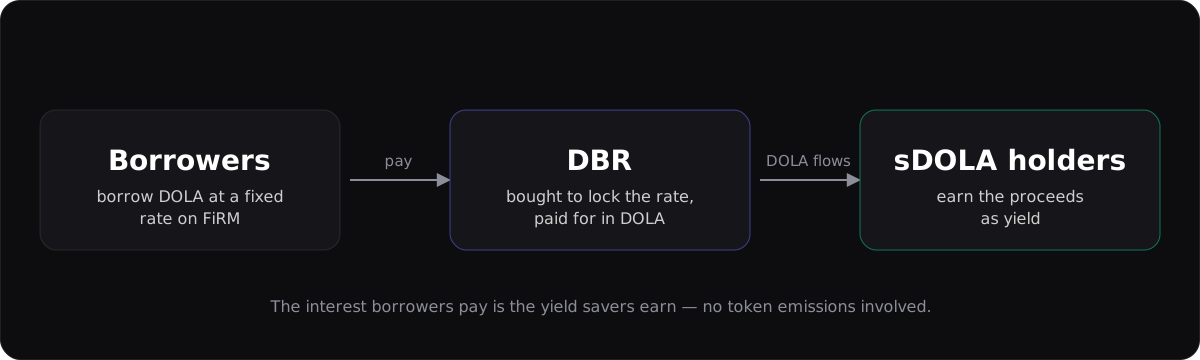
Inverse Finance runs a lending market called FiRM, where people borrow a stablecoin called DOLA at a fixed rate. To lock that rate in, borrowers buy something called DBR, which works like a tokenized interest rate. One DBR lets you borrow one DOLA for a year.
The money those borrowers spend buying DBR is what pays sDOLA holders. So the yield is funded by genuine borrowing demand, not by a token emissions program. When borrowing on FiRM is busy, sDOLA pays more. When it slows down, it pays less.
What is the advantage?
The yield is honest. It can't run ahead of the lending business underneath it, which is the exact failure that takes down emissions-funded stablecoins every cycle.
It's also simple to hold. sDOLA is a vault. You deposit DOLA, you get sDOLA, and your balance grows automatically as the protocol distributes revenue each week. There's nothing to claim and nothing to harvest, and the yield comes back as more DOLA, the same asset you put in.
Will it collapse like other stablecoins?
A fair worry, since plenty of stablecoins have broken before. The honest answer is that no stablecoin is risk-free, but DOLA has held up where others didn't.
In March 2023, Silicon Valley Bank failed and USDC dropped to around 87 cents over a weekend, dragging DAI down with it. DOLA barely moved and stayed within a fraction of a cent of a dollar.
That's partly by design. Every borrower has their own isolated collateral, so one bad loan stays contained instead of spreading. A junior layer called jrDOLA is built to absorb bad debt first, before it can touch DOLA's backing. And a stability module lets the protocol defend the peg directly when markets get rough. None of that guarantees the next stress event ends the same way, but it's real engineering aimed at a real problem.
How do you earn leveraged yield on Spiral Stake?
sDOLA is accepted as collateral across DeFi, including Curve Lend, Euler, Morpho, and Pendle. That's what lets you do more with it than just hold it.
On Spiral Stake, you deposit sDOLA and borrow USDC against it on a Morpho market. Your sDOLA keeps earning underneath, while the USDC you borrow usually costs less than that base yield, and sometimes much less when Inverse is paying rewards to borrowers. You earn on both sides at once. Add leverage, up to 10x, and a quiet single-digit yield turns into something much larger.
What are the risks?
Leverage cuts both ways. If sDOLA slips against USDC near the top of the range, your position can be liquidated. Borrow rates and any reward programs are variable and can change at any time. And like anything in DeFi, the underlying contracts carry smart-contract risk. Use leverage you can stomach, with money you can afford to lose.
See it live
Rates move constantly, so any number printed here would be stale by next week. The Spiral Stake pool shows the current yield, borrow cost, and leveraged APY in real time. Go see where it sits today.
Informational only, not financial advice. Rates and incentives change continuously, so verify live before depositing. DeFi carries risk of total loss, including smart-contract failure, liquidation, oracle failure, and depeg. Do your own research.
